
September was National Self-Care Awareness Month, so I decided to take some time away to engage in more self-care. During this time, I completed a mini digital detox by avoiding non work relating internet exposure. I took time off from work, spent time with family, and worked on some personal goals. There were also several other health awareness topics in September such as Suicide Prevention Month, National Recovery Month, Ovarian Cancer Awareness Month, and Polycystic Ovary Syndrome (PCOS) Awareness Month.
October also has many health awareness topics, with Breast Cancer Awareness being more commonly recognized. I will acknowledge the recent controversy with the word “breast” as some have advocated for the usage of the word “chest” to be more inclusive. For this blog, I will use the word “breast” out of respect for the prevalence of breast cancer in this country, survivors of breast cancer, and to stress the importance of properly examining both your “breast” and “chest” area during monthly self-breast examinations. I also want to acknowledge that both biological males and females have breasts and are both at risk of developing breast cancer. About 13% of the U.S. female population will develop breast cancer, making breast cancer the second most common cancer among women1. Of those cases 64% are localized (i.e., limited to the breast or breasts) which improves treatment prognosis1. Only 15% of women diagnosed with breast cancer have a family history of breast cancer1.
Breast cancer mortality rates in the United States overwhelming impact African American/Black women, as they are 40% more likely to die from breast cancer when compared to White women1. Hispanic women are more likely to be diagnosed with breast cancer at later stages when treatment is more difficult1. Screening recommendations such as having a mammogram after the age of 40, often contribute to barriers in diagnosis and treatment among younger women. Age isn’t the best predicator of being diagnosed with breast cancer as half of U.S. women are under age 63 when diagnosed and about 9% of all new breast cancer cases in the U.S. are diagnosed in women under age 451. Women who are diagnosed under age 35 have a higher risk of breast cancer recurrence1.
Many factors that contribute to developing breast cancer such as age, genetics, family history, breast density, reproductive history (i.e., age of menses onset, age of first full-term pregnancy, and age of menopause onset) cannot be changed. Some risk factors such as smoking, alcohol consumption, physical activity, use of hormone contraceptives, and breast feeding can be modified to reduce your risk of developing breast cancer. Smoking has been associated with higher risks of developing breast cancer in addition to increased alcohol consumption and lack of physical activity. Studies have shown that use of hormonal birth control has been shown to increase the risk of breast cancer while breastfeeding has been shown to decrease the risk of breast cancer2.
If you are someone who has denser breasts, which is more likely for younger women, women who are pregnant and/or lactating, and women with lower body fat then it is important to have conversations with your doctor about your risks and screening tests needed for early detection. Some recommendations may include a mammogram, ultrasound, or even an MRI. I am sharing a photo of a mammogram that compares a breast which has mostly fatty tissue (left photo) with a breast which has dense tissue (right photo).
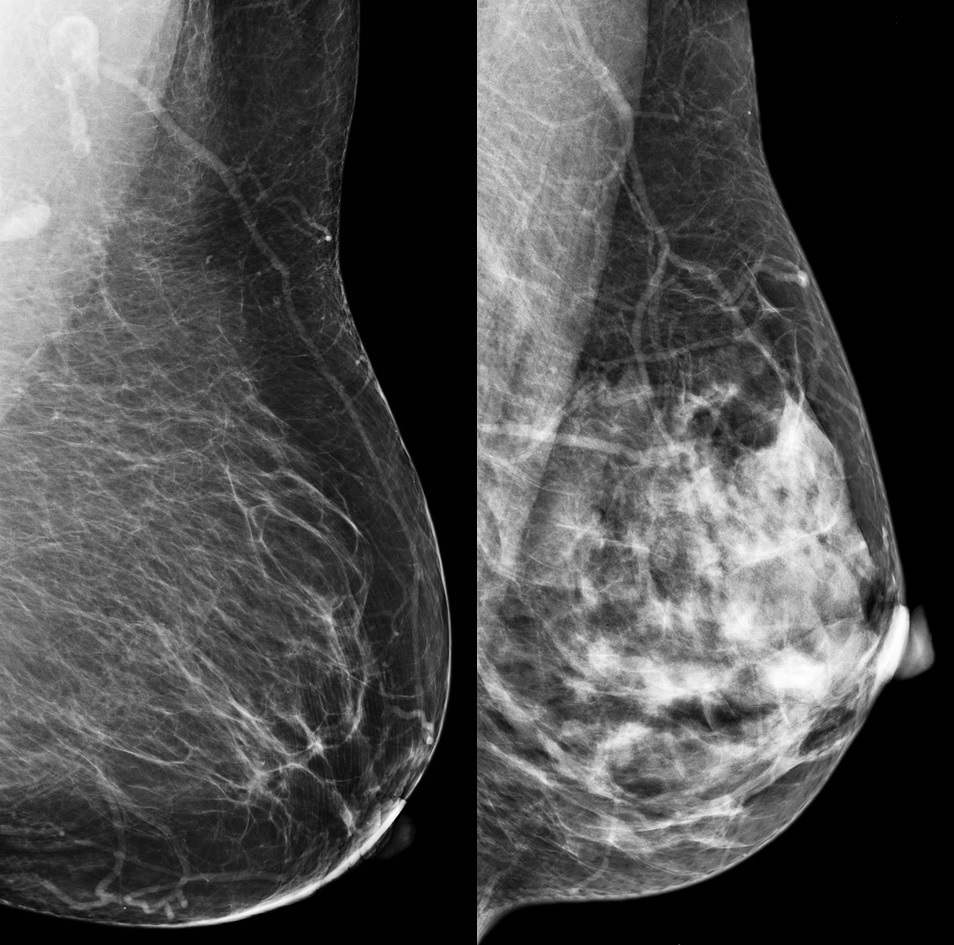
Source: Centers for Disease Control and Prevention Website
Regardless of your breast density it is important to regularly check your breasts monthly to monitor for new lumps, texture changes, nipple discharge, and nipple changes. While standing you need to look in the mirror for changes to your breast shape and size. This could be done daily in the morning or right before bed. At least once a month, you also need to examine your entire breast including, your under boob, armpit area, chest (above your breasts), and collar bone. You can complete this process while standing or laying down depending on your comfort and preference.
You start by raising one of your arms and then beginning to examine your breast in the outer area (i.e., starting at your armpit) and work in a circle examining the area including the chest up to where your collar bone begins.

Note: Check Under Your Arm Pit area

Note: Check Around Your Chest Area Starting at Your Collar Bone
With each pass you will move inward into the breast area until you have examined the entire breast including your nipple area. After completing one breast, repeat the process on the other breast.
Knowledge and breast self-awareness are both important when considering breast cancer prevention and early detection.
Wishing you health and happiness
References
- Breast Cancer Stats and Facts. National Breast Cancer Foundation Inc. Website. https://www.nationalbreastcancer.org/breast-cancer-facts/. Accessed October 8, 2023.
- Breast Cancer Risks. Centers for Disease Control and Prevention Website. https://www.cdc.gov/cancer/breast/basic_info/risk_factors.htm. Updated July 25, 2023. Accessed October 8, 2023.
 My Mind, My Body, My Journey™