
This weekend I will dedicate several posts highlighting the impact of women in the military, including women who made history in the military, health challenges among women in the military, and special challenges among military mothers, especially those who experienced deployments while caring for small children. This post will provide more information about the organization of the military and demographic factors of those in the military.
The U.S. military organization structure is complex. We have the Department of Defense which has the Army, Navy, and Air Force. The Army has its own department while the Navy and Marine Corps are both within the Department of the Navy. The Air Force and the Space Force are both within the Department of the Air Force. The Coast Guard is part of the Department of Homeland Security and although is a branch of the armed forces, it serves as a law enforcement agency predominately, but does deploy with the navy and marine corps for certain missions. We also have the reserve services which include the Army National Guard, Army Reserve, Navy Reserve, Marine Corps Reserve, Air National Guard, Air Force Reserve, and Coast Guard Reserve.
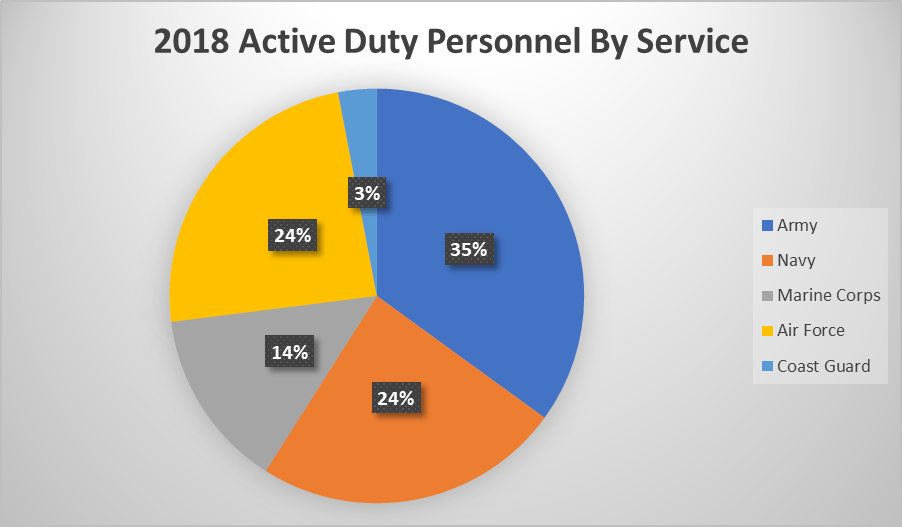
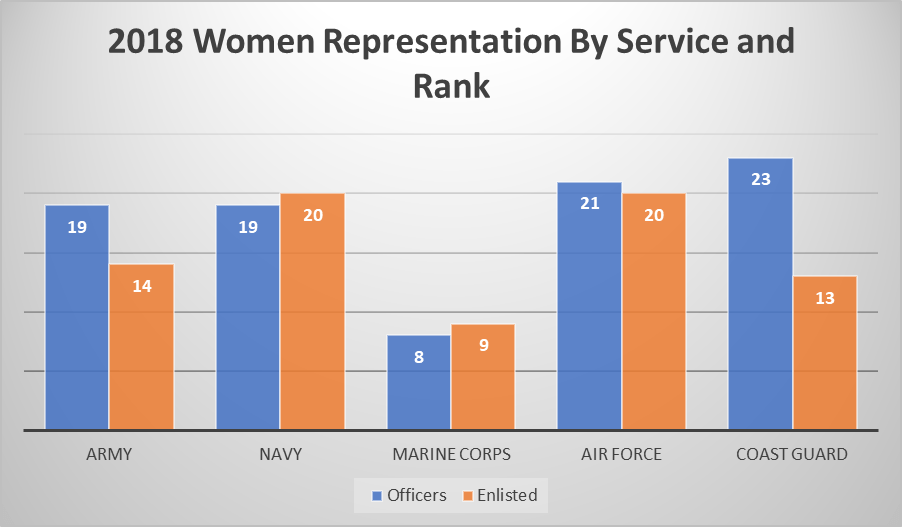
In 2018, there were 1.3 million active service military professionals, which represents .5% of the United States population1. Women represented 16% of the enlisted forces and 19% of the officer corps1. The pie chart below shows the breakdown of the service members by the military branch.
Source: Office of the Undersecretary of Defense
Due to age limitations, military members tend to be younger than civilian populations. It is important to note that members of our military are younger members of the population that are being exposed to several traumatic experiences during a crucial developmental period. For women, these stressors can impact reproductive health in addition to childrearing concerns.
Geographically, most recruits are represented among a few states in the United States such as Texas, California, Florida, Georgia, North Carolina, and New York1. Racially, most recruits are White, however, among female recruits, minority representation is higher1. This could pose additional challenges when caring for the health needs of women involved in the military given the racial health disparities and medical racism that remains prevalent in the United States.
Source: Office of the Undersecretary of Defense
According to the U.S. Department of Veteran Affairs women are the fastest growing group among veterans, with more than 2 million veterans residing in the United States2. Consistent with demographic trends regarding ethnic representation among female military recruits, women veterans are racially and ethnically diverse. In 2020 43% of women veterans that accessed services from the VA health system were women of color2. 75% of the women veterans that accessed services from the VA health system resided in urban environments2.
I want to thank all the women who served in the military, including recruits, officers, and those working in civilian positions.
Wishing you health and happiness.
References:
- Demographics of the U.S. Military. Council on Foregin Relations Website. https://www.cfr.org/backgrounder/demographics-us-military. Accessed November 10, 2023. Updated July 13, 2020.
- Women Veterans Health Care. U.S. Department of Veterans Affairs Website. https://www.womenshealth.va.gov/materials-and-resources/facts-and-statistics.asp. Accessed November 10, 2023. Updated June 23, 2023.
 My Mind, My Body, My Journey™